
Hidden and slab leaks
Leak Detection in Tahlequah, OK
A hidden leak does not knock. It shows up as a water bill that doubled, a warm patch on the floor, a wet strip in the yard in August, or a pump that never seems to stop on a house fed from a well. Leak detection in Tahlequah, OK means finding it before anybody cuts concrete or digs a trench — and then telling you what the repair costs.
- Licensed & insured
- Veteran-owned
- Indigenous-owned
Our approach
We find it first, then we quote the repair
Finding the leak and fixing the leak are two different jobs, and we price them that way so you are never paying for a guess. You get a flat price for the search before we start, and a separate flat price for the repair once we know what we are repairing.
If we cannot find it, we will tell you that instead of opening a wall and hoping. And if the honest answer is that your leak is one symptom of pipe that is finished, we will say so rather than sell you three repairs in a year.
How it works
Where your water comes from
Where your water comes from
More about leak detection
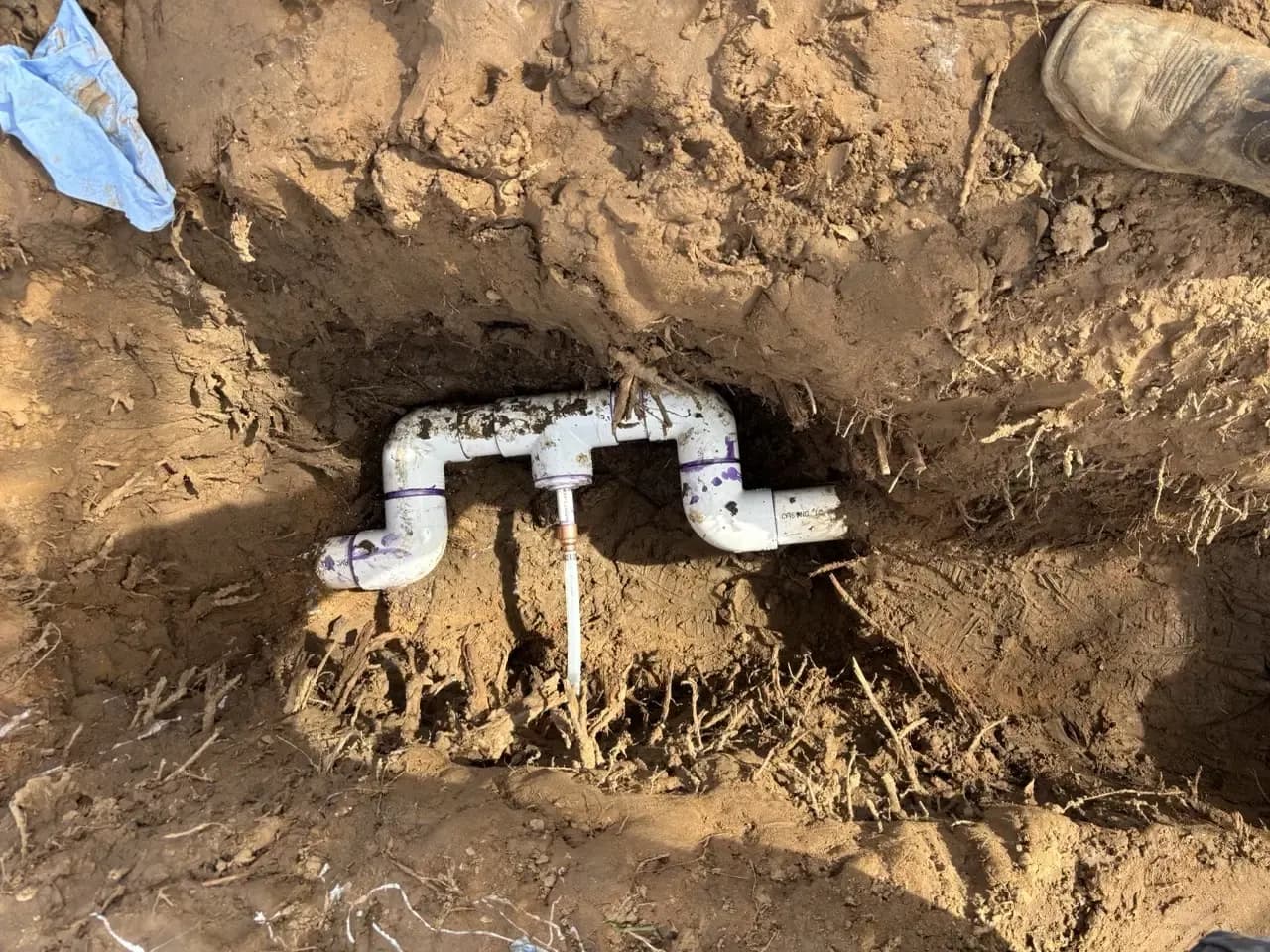
The yard line between the meter and the house
The classic high-bill leak. The meter turns with the house shut off, and nothing inside is wet. We isolate the house from the service line to prove which side the water is going out on, then locate the failure.
Slab leaks
A supply line under concrete gives you a warm spot on the floor, the sound of running water with nothing on, or a crack line that stays damp. We work out whether it is the hot or cold side and where the run goes before any concrete is opened.
Leaks under a pier-and-beam or manufactured home
Around here plenty of pipe runs in open air under the floor. That is a mercy: a leak under there is reachable. The tells are a musty crawlspace, an area of ground that stays wet under the home, or insulation hanging down where water has soaked it.
Leaks inside walls and ceilings
A stain, a soft patch of drywall, or a smell in one room. Water travels along framing, so we follow it back to the source instead of cutting where the stain is.
A pump that will not stop, on a house fed from a well
On a well there is no water bill to warn you. Instead the pump runs over and over, because water is going somewhere. We shut the house off, hold pressure and tell you whether the water is leaving inside the house. If it is the well system instead, that is a licensed pump installer's work, not ours: Oklahoma licenses well and pump work separately from plumbing.
The water bill jumped and nothing changed
Same people, same habits, twice the water. Tahlequah PWA reads the meter, so a jump with no explanation is usually real, and it is usually already costing you every day you wait.
The meter turns with everything off
Shut every fixture and appliance, then watch the meter dial. If it creeps, water is leaving the system. This is the one test a homeowner can do that tells a plumber the most.
A warm spot on the floor, or running water you cannot find
On a slab home, a warm patch or the sound of water with the house quiet points at a hot-water line under the concrete. Both are worth acting on quickly, because a slab leak undermines what it sits in.
Ground that stays wet in dry weather
A soft, green or sunken strip in the yard when everything else is brown. On a well property, the same tell plus a pump cycling at night is nearly conclusive.
The ground here swallows water. We sit on the Boone formation, a karst limestone with caves, springs, sinkholes and disappearing streams, under thin soils full of coarse chert. A broken underground line in this county can lose water for months and never show a puddle, because the water goes straight down through rock instead of pooling where you would see it. That is why we work from the meter and from pressure, not from wet grass alone.
Housing plays a part too. The median Cherokee County home dates from 1989, and 4,302 of the county's 22,363 housing units are manufactured homes. Older houses on piers and manufactured homes keep their pipe under the floor, where a leak is easier to find and easier to reach. Slab-on-grade houses hide it in concrete, which is a different search and a different repair.
If you are on city water, one more thing is worth doing while we are there. Tahlequah PWA is working through its lead service line inventory, and its annual water report invites customers to ask for access to it. Knowing what your service line is made of tells you something about both your water and the odds of another leak on that line. We will look at the pipe we can see and tell you what we find.
- 1
Meter test with the house shut down
We close the house off at the main and watch the meter. That answers the biggest question first: is the water leaving before the house, or inside it?
- 2
Isolate and narrow
We shut sections, hold pressure, check the water heater, the toilets, the hose bibs and any irrigation, and work the leak into the smallest area we can. Most of the job is eliminating everything it is not.
- 3
Locate as precisely as the pipe allows
Then we pin the spot down using the route of the pipe, moisture, temperature, sound and the way the ground or the floor behaves. We show you what we have, and how sure we are.
- 4
You get a flat price for the repair
Repair the section, or replace a run that is going to keep failing. You hear both, with the price, and you choose before anything is cut.
- Do the meter test. Turn off every tap, appliance and ice maker, then watch the meter dial for ten minutes. Take a photo at the start and the end.
- Put a few drops of food coloring in each toilet tank and wait twenty minutes without flushing. Colour in the bowl means that toilet is your leak.
- Check the simple outside things: hose bibs, a hose left half on, and any irrigation or stock water line.
- Keep the old bills. A bill history that shows when the jump started tells us how long this has been running.
- If water is near wiring, a panel or the furnace, switch off that circuit first.
- If the leak is flooding and you cannot stop it, shut the main off at the meter or at the pressure tank. We answer 7 AM to 5 PM and we are not a 24-hour company.
A single leak in sound pipe is a repair, and a good one lasts for decades. That is most of what we find.
But when a line has leaked in two or three places in a couple of years, the pipe itself is telling you something. Old galvanized steel, early plastic supply line, or a run that has been patched repeatedly will keep failing somewhere new. At that point repiping that run costs less over five years than chasing it. We will show you what the failed section looks like from the inside — it usually settles the argument.
We quote a flat price for the search before we begin, and we hold it whether the leak turns up in twenty minutes or takes all morning. Then the repair is quoted separately, once we know what needs doing, and you approve that too.
Two honest notes. If the meter test proves the leak is on the utility's side of the meter, that is their pipe and we will tell you to call them instead of paying us. And if the fix turns out to be a toilet flapper, we will tell you that as well.
What changes the price
- Where the leak is: an open crawlspace, a wall, a yard line, or under a concrete slab
- How long the run is, and whether the pipe route is known or has to be traced
- The pipe material, and whether fittings for it are still available
- Whether the repair is a section or a replacement of the whole run
- Whether replacing pipe triggers a city permit and inspection
- What has to be put back afterwards: concrete, drywall, insulation or yard
Straight answers
Leak Detection questions, answered
Not answered here? Call or text Dustin at (918) 822-7918.
How much does leak detection cost in Tahlequah?
You get one flat price for the search, quoted before we start, and it does not change if the leak hides well. The repair is a separate flat price you approve after we know what failed. What moves those numbers is where the leak is, whether concrete has to be opened, and whether we are repairing a section or replacing a run. Call or text (918) 822-7918 with what your bill did and what you can see.
How do I know if I have a hidden water leak?
Start with the meter. Turn everything off, including ice makers and irrigation, and watch the dial for ten minutes. Movement means water is leaving the system. Then dye-test the toilets, because a running toilet is the most common cause of a big bill. If the meter still moves with the toilets ruled out, the leak is in the pipe and worth finding properly.
What does a slab leak feel like?
Most often a patch of floor that is warmer than the rest, the sound of water running with the house silent, and a water bill that climbed. Sometimes a crack in the slab that stays damp, or a baseboard that will not dry. A slab leak does not get better, and the water goes under the house, so it is worth acting on as soon as you suspect it.
My well pump keeps cycling on and off. Is that a leak?
It can be. A pump that starts when nobody has used water means pressure is dropping somewhere, and a leak in the house lines is one reason. We can shut the house off and test the house side for you. If the house holds pressure, the fault is in the well system — a pressure tank that has lost its air charge, a worn switch or a failing check valve — and that is a licensed pump installer's job.
Will the water utility adjust my bill for a leak?
Some utilities have a policy for that and some do not, so ask Tahlequah PWA or your rural water district directly — and ask before you pay the bill. What helps your case is a dated repair record showing what failed and when it was fixed, which we will give you either way.
Can you find a leak without cutting into anything?
That is the whole point of doing it properly. We work from the meter, pressure, isolation and the route of the pipe, so that when something is opened, it is opened where the leak actually is. On a slab or in a finished wall we will tell you how certain we are before anybody cuts.
Related services
- Plumbing RepairLeaks, clogs, running toilets and valves that will not shut off. Price quoted before we start.
- RepipingOld galvanized, polybutylene or patched-up pipe replaced in PEX, planned so you keep water most of the day.
- Frozen & Burst PipesThawing, burst-pipe repair and winterizing for Cherokee County homes, crawlspaces and lake cabins.
- Faucets, Toilets & DisposalsFaucets, toilets, disposals and shower valves. Small jobs welcome, and we call you back.
Where we do this most
- Leak Detection in TahlequahOur home base
- Leak Detection in Park HillAbout 17 minutes from our shop
- Leak Detection in WellingAbout 21 minutes from our shop
- Leak Detection in HulbertAbout 18 minutes from our shop
- Leak Detection in KeysAbout 21 minutes from our shop
We cover all of Cherokee County. See the full service area.
Need leak detection in Tahlequah?
Call Dustin at (918) 822-7918, or text a photo with your town. One flat price before any work starts.