
Replacing old pipe
Whole-House Repiping in Tahlequah, OK
There comes a point where fixing one more leak is throwing good money after bad. A repipe in Tahlequah, OK replaces the supply pipe in the house — usually with PEX — so you stop patching, stop losing pressure, and stop wondering which joint goes next. We quote the whole job as one flat number before we open a wall.
- Licensed & insured
- Veteran-owned
- Indigenous-owned
Our approach
One price for the whole house, in writing
A repipe is the biggest plumbing job most houses ever get, which is exactly why it should not be billed by the hour. We walk the house, plan the routes, and give you one flat price for the whole scope. That number holds if a stud bay is blocked or a fitting behind the tub turns into a wrestling match.
We also tell you plainly what is included and what is not: which walls open, what we patch, what we leave for a drywall finisher or a painter, and whether the line from the meter to the house is part of the job. Surprises in a repipe are almost always about scope, so we write the scope down.
How it works
Where your water comes from
Where your water comes from
More about repiping
Galvanized steel replacement
Galvanized pipe rusts from the inside out. The bore closes up with scale until the pressure is gone, then it starts weeping at the threads. If your house still has steel supply pipe, replacing it fixes pressure, water color and leaks in one job.
Polybutylene and early plastic supply
Grey or grey-blue plastic pipe with crimped bands was installed in a lot of houses and manufactured homes between the late 1970s and the mid 1990s. It fails at the fittings, often with no warning. If that is what you have, a repipe is not an upsell.
Repipe in PEX
PEX is what we normally run: fewer joints, it tolerates a freeze better than rigid pipe, it can be pulled through framing without opening every wall, and it does not scale up like steel. Where copper is the right answer for a section, we will say so.
The service line from the meter to the house
The pipe between the meter and the house is often the oldest and worst thing on the property. It can be done with the house repipe or on its own, and we price it separately so you can see the choice.
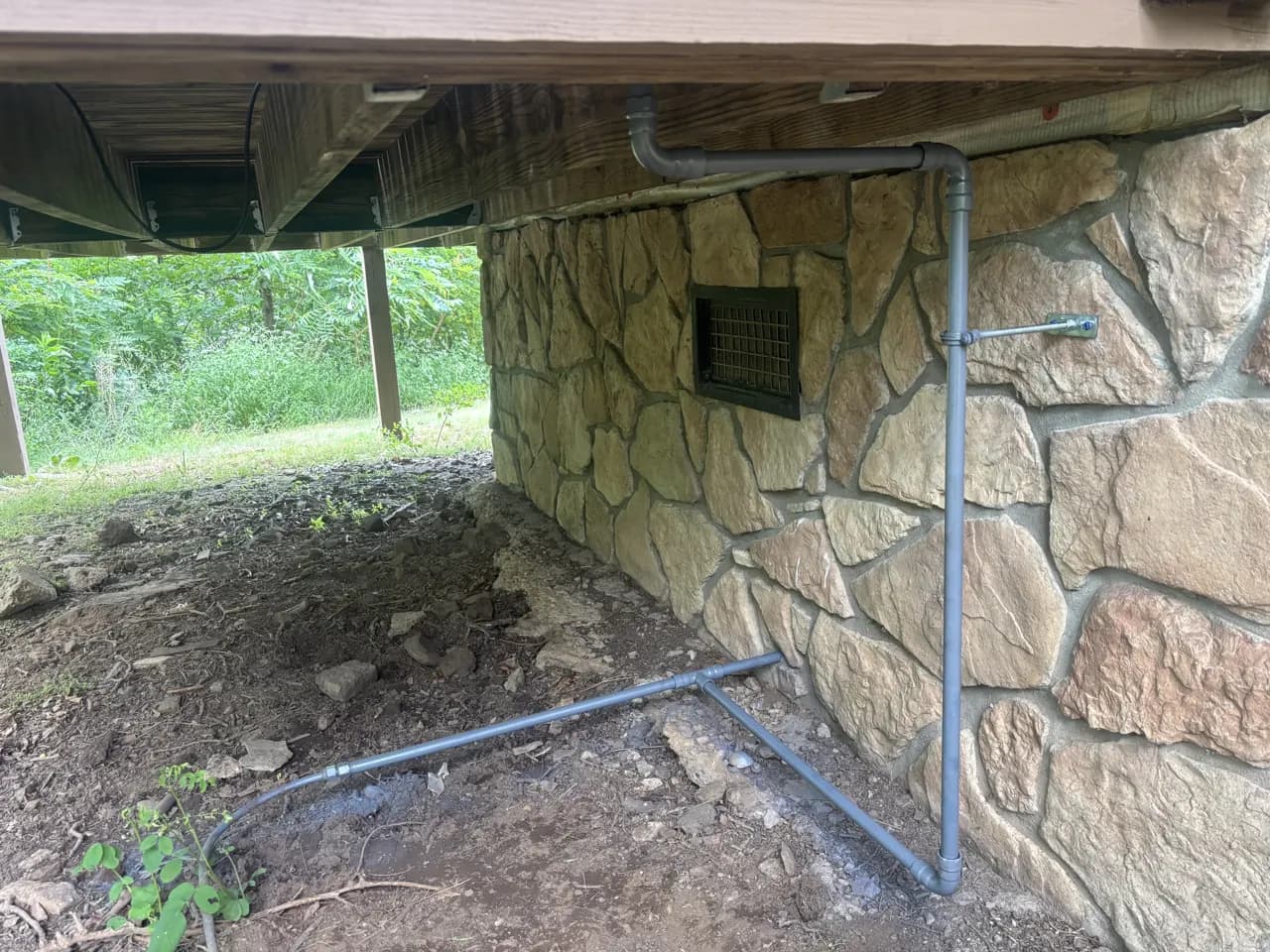
Under-floor and crawlspace runs
On pier-and-beam houses and manufactured homes the supply runs under the floor. A repipe there is straightforward work, and it is the chance to get insulation, strapping and freeze protection right at the same time.
A repipe planned around your day
We stage the work so the water is off for as little of the day as we can manage, and we aim to leave you a working toilet and sink at the end of each day. If we have to leave the water off overnight, you hear that before we start, not at five o'clock.
Rusty or brown water when a tap has been sitting
Water the color of weak tea for the first few seconds, especially on hot, means the inside of the pipe is coming apart. Filters mask it. They do not fix it.
Pressure dies when a second fixture runs
Flush the toilet while somebody is in the shower. If the shower nearly stops, the pipe has lost most of its inside diameter to scale, and no fixture or regulator will get it back.
You have had more than one pinhole leak
Two leaks in two years on the same system is a pattern, not luck. The next one is coming, and it may be behind drywall or over a ceiling instead of in the crawlspace.
You can see steel or grey plastic pipe
Look under a sink, in the crawlspace, or where the water heater connects. Threaded steel pipe or grey plastic with crimp rings tells you most of the story before anybody quotes anything.
The numbers are blunt. The census puts the median Cherokee County home at 1989 — around 37 years old — and 7,926 of the county's 22,363 housing units, better than a third, were built in 1979 or earlier. That is the exact age band where galvanized steel closes up, early plastic supply lets go at the fittings, and a house has already had two water heaters.
Two dates are worth knowing. Congress amended the Safe Drinking Water Act in 1986 to prohibit pipe, solder and flux that were not lead free, so plumbing installed before that can contain lead solder at the joints. And the polybutylene class action covered pipe installed between January 1978 and July 1995 — a window that takes in a large share of the houses and manufactured homes built here in that era. If your house is from those years, what your pipe is made of is worth knowing before it tells you itself.
Water and weather finish the argument. On a private well, hard water is the norm here: a state study of the Boone groundwater basin measured hardness in its well samples at a median of 185 mg/L, and hard water leaves scale inside old pipe. In January this county averages about 35 degrees, and a great deal of local supply pipe runs under a floor in open air rather than inside a heated wall, which is where a freeze finds it.
One extra thing worth asking while the walls are open: Tahlequah PWA is working through its initial lead service line inventory and its annual water report invites customers to ask for access to it. If you are on city water, that tells you what the utility believes your service line is made of. We will tell you what we actually find on your side of the meter.
- 1
We walk the house and identify what you have
Pipe material, where it runs, how many fixtures, where the attic and crawlspace get tight, and where the water heater and laundry sit. We tell you what we found before we talk about price.
- 2
You get a written scope and one flat price
What is being replaced, what is being left, which walls open, what we patch, and whether the service line is included. You approve that before a single hole is made.
- 3
We run new pipe, staged around the house
New lines get pulled and manifolded, then tied in room by room. We keep the water on as much as the work allows and tell you each day what tomorrow looks like.
- 4
Pressure test, inspection, then close up
Inside the city, a repipe is permitted work and the city pressure-tests the water lines at no less than the working pressure of the system. We get it signed off, then close up to the scope you approved.
- Take a photo of the pipe you can see: under the kitchen sink, at the water heater, and in the crawlspace or under the skirting.
- Count your bathrooms, and tell us about anything unusual — an outside bathroom, a shop sink, a second water heater, an irrigation tap.
- Note whether the house is on a slab, on piers, or a manufactured home, and whether there is attic access.
- If you have had leaks, write down roughly when and where. The pattern tells us as much as the pipe does.
- Clear access to the crawlspace hatch and to the wall where the water heater sits.
- If you are buying the house, get the repipe quoted before closing. It is much easier to plan than to discover.
Repair is right when the rest of the system is sound: a single failed section, a bad fitting, damage from a freeze in one spot. We fix plenty of those and never mention repiping.
Repipe is right when the material itself is finished, when pressure has gone everywhere, or when you are on your third leak. It is also the cheaper decision when walls are already open for a remodel, because the labor is half the job and you are paying for that access anyway.
If you are somewhere in the middle, we will quote both, tell you which one we would choose in your house, and let you decide with real numbers in front of you.
One flat price for the agreed scope, quoted before we start, and it does not move because a joist bay was blocked or a fitting fought us. No hourly meter on a job this size — that is the whole point.
We will also tell you where you can save money without regretting it: doing the house now and the yard line later, leaving the drywall patching to your own finisher, or running new pipe on an accessible route instead of chasing the original one through finished walls.
What changes the price
- How many fixtures and bathrooms the house has
- Construction: slab, pier-and-beam, manufactured home, or two stories
- How much of the run is accessible through an attic, crawlspace or under-floor space
- Whether the service line from the meter to the house is included
- What has to be put back: drywall patching, tile, insulation, skirting
- Permit and inspection where the work is inside the city limits
Straight answers
Repiping questions, answered
Not answered here? Call or text Dustin at (918) 822-7918.
How much does it cost to repipe a house in Tahlequah?
It depends mostly on fixture count and access, so we quote your house rather than an average. You get one flat price for a written scope before we start, and it holds. The things that move it are the number of bathrooms, whether we are working in a crawlspace or opening finished walls, whether the yard service line is included, and how much patching you want us to do. Call or text (918) 822-7918.
Should I repipe in PEX or copper?
We normally run PEX. It has fewer joints, handles a freeze better than rigid pipe, can be pulled through framing without opening every wall, and does not scale up the way steel does. Copper still earns its place in short exposed runs and some connections, and we will tell you where we think it is worth using in your house.
How long will my water be off?
We plan the work so the water is off for part of the day rather than all of it, and we aim to leave you a working toilet and sink each evening. How long depends on the size of the house and the routes available. You will get that answer as part of the quote, before you commit — not as a surprise at five o'clock.
Do you have to tear the walls out?
Not usually all of them. Most of a repipe can be routed through an attic, a crawlspace or under the floor, with small openings where a line has to come into a wet wall. We show you where each opening will be before we start, and the scope says who patches them.
How do I know if I have polybutylene pipe?
Look for grey, or sometimes grey-blue, flexible plastic pipe about the diameter of your finger, joined with crimped metal bands. It often shows up at the water heater, under sinks, or coming through the floor of a manufactured home. The class action that made it famous covered pipe installed between 1978 and 1995, so the age of the house is a strong hint.
Do I need a permit to repipe in Tahlequah?
Yes, inside the city limits. Replacing or rearranging pipe is new work under the city's plumbing code, so it needs a permit and an inspection, and water lines get pressure-tested to at least the working pressure of the system. Outside the city, where there is often no local inspector, we file the state notification instead. Either way, that is our job to handle.
Related services
- Leak DetectionHigh water bill, a wet spot, or a meter that keeps turning. We find the leak before we open anything.
- Plumbing RepairLeaks, clogs, running toilets and valves that will not shut off. Price quoted before we start.
- Mobile Home PlumbingUnder-floor lines, frozen crossovers, water heater closets and low clearance. We work under homes.
- Frozen & Burst PipesThawing, burst-pipe repair and winterizing for Cherokee County homes, crawlspaces and lake cabins.
Where we do this most
- Repiping in TahlequahOur home base
- Repiping in Park HillAbout 17 minutes from our shop
- Repiping in HulbertAbout 18 minutes from our shop
- Repiping in BriggsAbout 6 minutes from our shop
- Repiping in MoodysAbout 17 minutes from our shop
We cover all of Cherokee County. See the full service area.
Need repiping in Tahlequah?
Call Dustin at (918) 822-7918, or text a photo with your town. One flat price before any work starts.